 English
 русский
 Français
 Español
 Português
 Deutsch
 عربى
عربى Türk
Türk
Content
- 1 Common Types of Steel Wire Rope Press Machine and Their Key Features
- 2 Working Principle and Structure of a Wire Rope Pressing Machine
- 3 Typical Crimping Force by Wire Rope Diameter
- 4 Applications and Selection Guide for a Steel Wire Rope Press Machine
- 5 Production Output Trend as Operators Gain Experience
- 6 Detailed Comparison: Hydraulic Press vs Mechanical Press vs Manual Swaging
- 7 Maintenance Guidance for a Wire Rope Press Machine
- 8 Strength Retention Achieved with Correct Hydraulic Pressing
- 9 Choosing an Experienced Wire Rope Press Machine Manufacturer
- 10 Frequently Asked Questions About Steel Wire Rope Press Machines
- 10.1 Q1: What is the difference between a wire rope press machine and a swaging machine?
- 10.2 Q2: What rope diameter range can a steel wire rope press machine handle?
- 10.3 Q3: How much hydraulic force does a wire rope pressing machine typically generate?
- 10.4 Q4: Can a wire rope press machine be used with both aluminum and steel ferrules?
- 10.5 Q5: How often should dies be replaced on a steel wire rope press machine?
- 10.6 Q6: What should buyers check before ordering from a wire rope press machine supplier?
A steel wire rope press machine permanently attaches a sleeve, ferrule, thimble, or fitting to the end of a wire rope by applying controlled radial compression with a hydraulic cylinder. A correctly pressed termination can retain most of the rope's original breaking strength, which is why a wire rope press machine is the standard tool for producing slings, cable assemblies, and rigging terminations across construction, marine, mining, and lifting industries. The sections below explain how a wire rope pressing machine works, how to select the right frame and tonnage, how it compares with other termination methods, and how to keep it running reliably for years of production use.
Common Types of Steel Wire Rope Press Machine and Their Key Features
Buyers researching a steel wire rope press machine usually find that the market is organized around frame shape and tonnage rather than a single universal design. The frame determines how the rope and sleeve are positioned during compression, while the tonnage determines the maximum rope diameter and ferrule material the machine can process in one cycle. Understanding these two variables first makes every later decision, from workshop layout to die selection, far easier to plan.
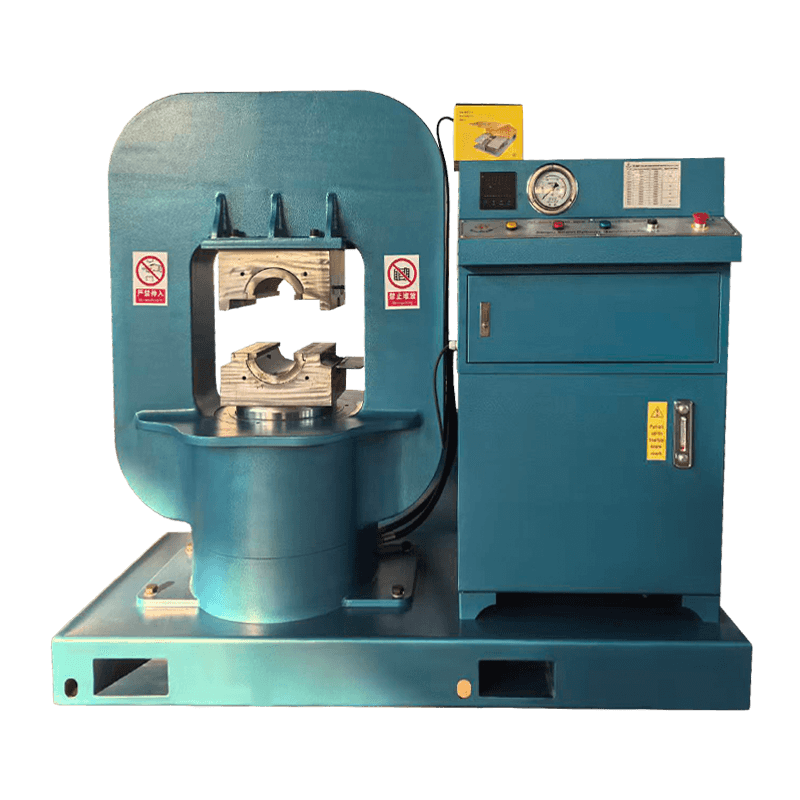
C-frame models are compact, open on three sides, and built for fast loading of short rope sections. They are common on production benches that need to turn out many small to medium terminations per shift, such as sling manufacturing lines. Basket-frame models enclose the ram and dies within a stronger closed structure, which allows the machine to reach much higher tonnage without flexing under load, making them the usual choice once rope diameter climbs past the mid-size range.
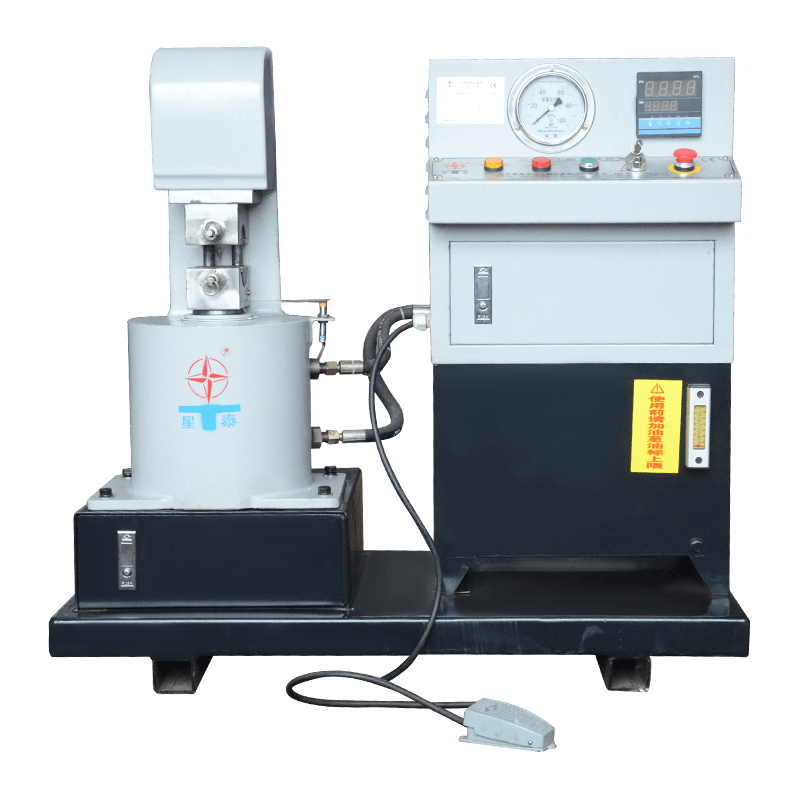
Bench-mounted units are designed for workshops with limited floor space or mobile service vehicles, offering enough force for smaller diameter rope while remaining light enough to move between job sites. Floor-standing basket-frame presses, by contrast, are bolted down permanently and are built to run continuously in facilities producing heavy rigging assemblies, crane ropes, or mining sling terminations at high volume.
- C-frame wire rope press machine models: fast cycle times, compact footprint, suited to smaller diameter rope
- Basket-frame wire rope pressing machine models: higher rated tonnage, closed structure for stability under heavy load
- Bench and portable units: lighter weight, suited to field service and lower volume workshops
- Floor-standing high tonnage units: continuous duty, larger diameter rope, heavy rigging production
Most current models are also fitted with interchangeable die sets, letting a single frame handle a range of rope diameters simply by swapping the compression dies rather than purchasing a separate machine for every size. Some newer units add digital pressure readouts, stroke counters, or basic data logging so a workshop can track output and support quality documentation over time.
A well specified steel wire rope press machine is chosen by matching frame type and tonnage to the largest rope diameter and highest production volume the workshop expects to handle, not simply the smallest available unit.
Working Principle and Structure of a Wire Rope Pressing Machine
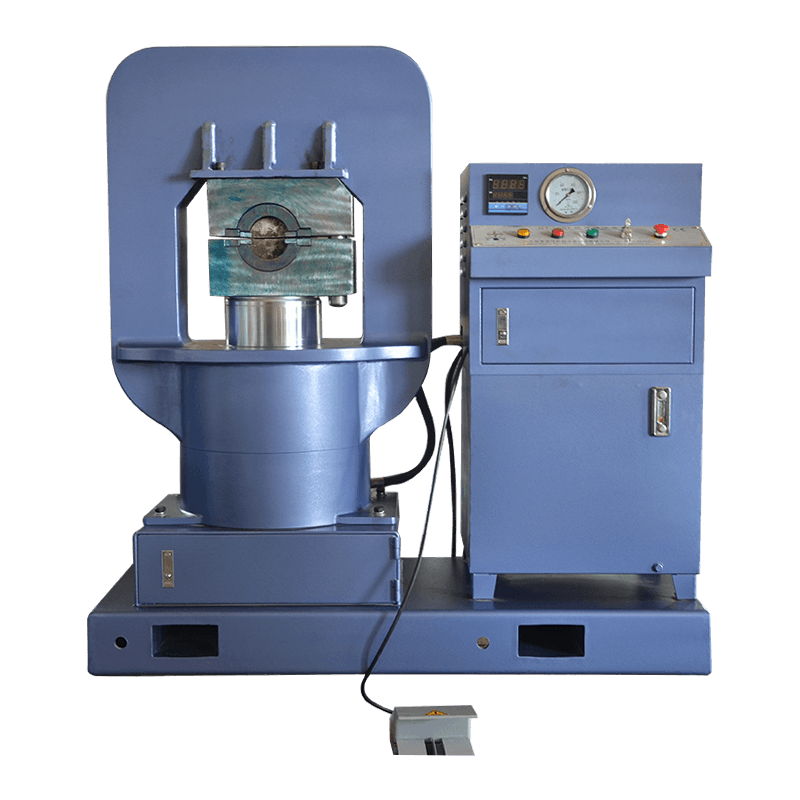
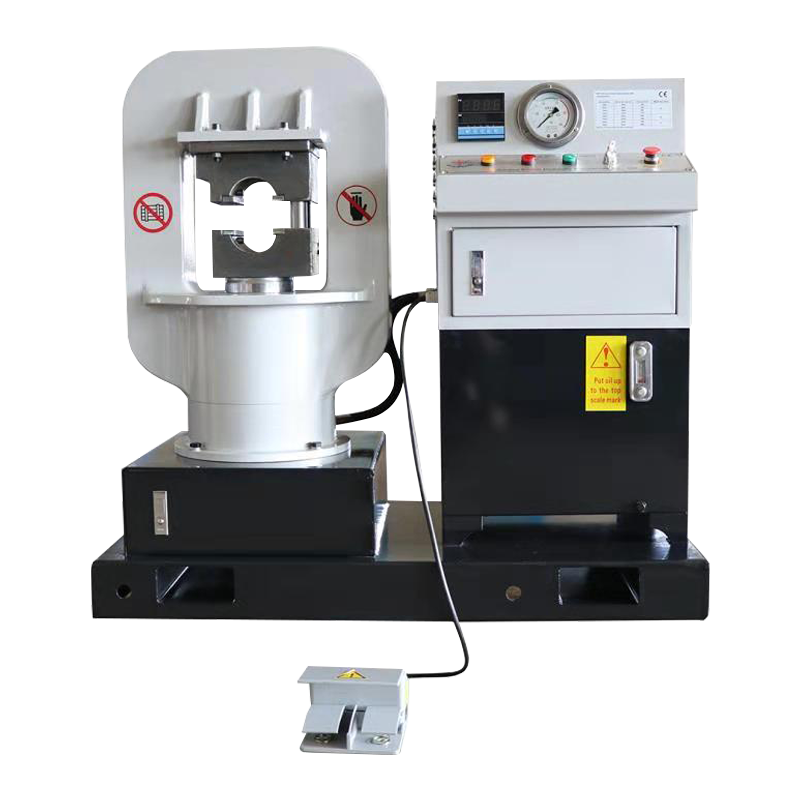
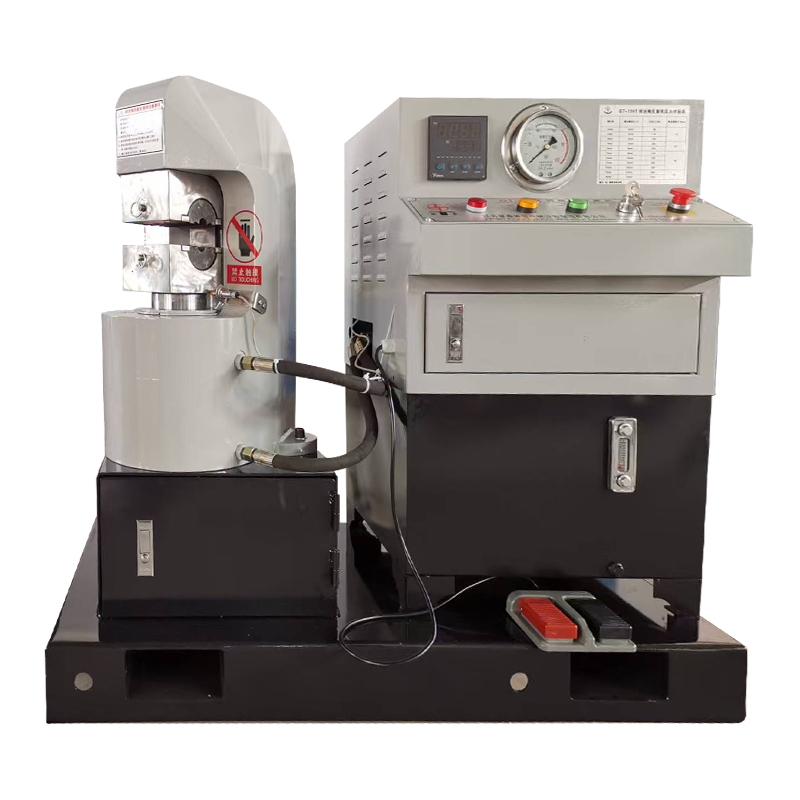
Inside a wire rope press machine, a hydraulic cylinder drives a set of shaped dies inward around a metal sleeve that has been slid over the rope end. As the dies close, the sleeve is plastically deformed and cold-flows into the strands of the rope, locking the fibers of the wire together without cutting or overheating them. Because the deformation happens gradually under controlled pressure, the finished termination keeps a smooth, rounded profile rather than sharp edges that could snag or wear against other rigging hardware.
Hydraulic Power Circuit
A dual-pump oil supply is common on mid to high tonnage frames: a low-pressure, high-flow pump moves the ram quickly into position, then a second high-pressure, low-flow pump takes over for the final compression stroke. This arrangement shortens cycle time on the approach stroke while still delivering full rated force during the actual pressing action, which improves both consistency and daily output compared with a single fixed-speed pump design.
Frame and Die Construction
The main body of a durable wire rope pressing machine is typically machined from a single forged or cast block rather than welded plate sections, which reduces the risk of frame distortion after repeated high-tonnage cycles. Dies are forged from high-strength alloy steel and heat treated to resist wear from constant contact with harder ferrule materials, and interchangeable die sets allow the frame to accept multiple rope diameters and sleeve profiles without modification.
| Component | Function |
|---|---|
| Hydraulic cylinder and ram | Generates and transmits compression force to the dies |
| Dual-pressure oil pump | Provides fast approach speed and controlled final pressing force |
| Forged alloy steel dies | Shape and compress the sleeve or ferrule around the rope |
| Single-block machine body | Maintains alignment and resists distortion under repeated load |
| Pressure gauge or digital readout | Confirms the compression cycle reached the target pressure |
A single-block forged frame combined with a dual-pressure hydraulic circuit is what allows a modern wire rope pressing machine to keep both speed and compression accuracy stable over long production runs.
Typical Crimping Force by Wire Rope Diameter
Before choosing a steel wire rope press machine, it helps to understand roughly how much hydraulic force different rope diameters require, because tonnage is the single factor most workshops get wrong when they buy on price alone. Thin ropes used for elevator cables or light rigging need only a fraction of the force required for thick mining or crane rope, so a machine sized for one end of the range is usually a poor fit for the other. The chart below sets out typical force ranges used across common industrial rope sizes, based on general industry practice for hydraulic swaging equipment. These figures are illustrative guidance rather than a guarantee for any specific rope construction, since core material, lay type, and ferrule alloy all shift the exact number somewhat. Reading the chart from top to bottom shows how quickly required tonnage rises as diameter increases, which is the main reason larger machines use a basket frame instead of a lighter C-frame.
The chart shows a clear, steady climb in required tonnage as rope diameter increases, and the curve steepens noticeably once diameter passes the mid-range. This pattern explains why a bench-style wire rope press machine rated for thin cable is not simply a smaller version of a large basket-frame unit; the internal cylinder, die block, and frame all need to be engineered differently to survive the much higher forces used on thick rope. Workshops that plan to process a wide diameter range often standardize on one higher-tonnage wire rope pressing machine with interchangeable dies rather than owning several separate frames, since it simplifies training and reduces floor space. The jump between 16mm and 32mm rope in the chart is a useful reference point: production lines built mainly for crane sling assembly typically sit in that middle-to-upper band, while elevator or light rigging lines rarely need to leave the lower end of the scale. Selecting a frame with some reserve capacity above the largest rope currently produced is a common practice, since it allows a workshop to accept larger orders later without replacing the equipment. Buyers sourcing from a China wire rope press machine manufacturer should always confirm the rated tonnage against their own heaviest rope and ferrule combination rather than relying on general reference figures such as these.
Applications and Selection Guide for a Steel Wire Rope Press Machine
A steel wire rope press machine is used wherever a wire rope termination has to carry real structural or lifting load rather than simply hold a decorative fitting. Overhead crane manufacturers use it to produce sling and hoist rope assemblies, marine rigging shops use it for anchor lines and mooring wires, mining operations use it for dragline and hoist rope terminations, and elevator installers use it for suspension and governor rope ends. Each of these applications puts slightly different demands on the machine, which is why selection should start from the application rather than from the machine specification sheet alone.
| Application | Typical Rope Range | Frame Suggestion |
|---|---|---|
| Overhead crane slings | 8mm to 22mm | Mid-tonnage basket frame |
| Marine and mooring rigging | 6mm to 16mm | Compact C-frame or bench unit |
| Mining dragline and hoist rope | 28mm to 52mm | High-tonnage basket frame |
| Elevator suspension rope | 6mm to 12mm | Compact bench or C-frame |
Beyond rope diameter, three other factors usually decide the final choice of frame. Production volume determines whether a manual-cycle bench unit is enough or whether a faster dual-pump basket frame is justified by throughput. Ferrule material matters because copper or steel sleeves generally require more force than aluminum for the same rope diameter, so a machine that is only just adequate for aluminum can be undersized once the ferrule material changes. Available floor space and power supply also constrain the choice, since larger basket-frame units need more clearance for loading long rope sections and typically draw more electrical power for the hydraulic pump motor.
Working with a China Wire Rope Press Machine Supplier
Because rope diameter, ferrule alloy, and production targets interact, most workshops find it useful to confirm frame and die selection directly with a wire rope pressing machine supplier before ordering, rather than choosing tonnage from a catalog figure alone. A supplier that also offers annealing and rolling equipment for the same rope range can be a practical single source for a full termination line, reducing the coordination needed between separate machine and accessory vendors.
The right wire rope press machine for a given workshop is determined by the largest rope diameter, the toughest ferrule material, and the expected daily cycle count, not by the smallest unit that technically fits the budget.
Production Output Trend as Operators Gain Experience
Workshop managers evaluating a new wire rope pressing machine often ask how quickly a production line reaches its stable output rate after the equipment is installed. In practice, output rarely starts at full capacity on day one, because operators need time to become comfortable with die changeovers, loading sequences, and pressure confirmation checks. The line chart below illustrates a typical ramp-up pattern over the first six weeks of running a new mid-tonnage press on standard diameter rope, based on general workshop training patterns rather than any single facility's exact figures. Understanding this ramp curve is useful for setting realistic delivery timelines when a new line is commissioned. It also explains why training time is often built into the commissioning schedule for a new steel wire rope press machine rather than treated as a minor afterthought.
The line rises steadily rather than jumping suddenly, which reflects how confidence with die changeovers and pressure verification builds gradually rather than all at once. In the first week, output is limited mainly by the time operators spend double-checking each setup step before running the ram, which is a normal and reasonable precaution during the learning phase. By the third and fourth weeks, most operators have internalized the loading sequence for common rope diameters, and the main remaining bottleneck tends to be die changeovers between different sizes rather than the pressing cycle itself. The curve begins to flatten from around week five onward, which typically signals that the line has reached a repeatable, stable rate that can be used for realistic production planning. Facilities that also invest in structured operator training, rather than informal on-the-job learning alone, generally reach this plateau somewhat faster than the pattern shown here. A wire rope press machine with clearly labeled die sets and simple pressure confirmation displays tends to shorten this ramp-up period further, since less time is spent verifying setup manually. This trend is a helpful planning tool for procurement teams estimating how soon a new termination line will meet delivery commitments after installation of a new wire rope pressing machine.
Detailed Comparison: Hydraulic Press vs Mechanical Press vs Manual Swaging
Wire rope terminations can be produced by several different methods, and comparing them side by side makes the advantages of a dedicated steel wire rope press machine easier to evaluate. Manual swaging relies on hand tools or simple lever presses and is generally reserved for very light duty or temporary connections where full rated strength is not required. Mechanical presses use a screw or cam mechanism rather than hydraulics, offering more consistency than manual methods but usually less force and slower cycle times than hydraulic equipment. Hydraulic wire rope press machines sit at the top of this comparison for most industrial applications because they combine high force, repeatable compression, and reasonably fast cycle times.
The radar chart shows the hydraulic press outline sitting closer to the outer edge across most axes, particularly strength retention, consistency, and fatigue life, which are the three factors that matter most for safety-critical lifting applications. Mechanical presses form a smaller but still respectable shape, generally trading some speed and force for a simpler mechanical design that needs less maintenance infrastructure. Manual swaging forms the smallest shape near the center, reflecting that it remains useful mainly for light duty or temporary work rather than structural lifting terminations. Portability is the one axis where the pattern reverses somewhat, since smaller manual tools and light mechanical presses can be easier to carry to a remote job site than a full hydraulic frame.
Consistency is worth highlighting separately, because it affects quality control as much as raw strength. A hydraulic wire rope press machine with a pressure-controlled cycle produces a very similar compression result on every unit, which is difficult to guarantee with hand tools where operator technique and fatigue can vary from one termination to the next. This is one reason many quality-focused fabrication shops standardize on hydraulic pressing even for rope diameters that a mechanical press could technically still handle. Fatigue life, meaning how many load cycles the termination withstands before any sign of wear, also tends to favor hydraulic pressing because the smoother, more even compression reduces stress concentration points within the sleeve. Workshops producing safety-critical assemblies for cranes or elevators generally treat hydraulic pressing as the baseline expectation rather than an optional upgrade.
Across strength, consistency, and fatigue life, a hydraulic steel wire rope press machine generally outperforms mechanical presses and manual swaging, which is why it remains the standard choice for load-bearing terminations.
Maintenance Guidance for a Wire Rope Press Machine
Routine maintenance is what keeps a steel wire rope press machine producing accurate, repeatable terminations year after year, and most of the required checks are simple enough to build into a daily or weekly schedule without specialized tools. Hydraulic oil condition should be checked regularly, since contaminated or degraded fluid is one of the most common causes of inconsistent pressing force over time. Filters should be replaced on the schedule recommended by the equipment manufacturer, and oil should be topped up or changed whenever it appears cloudy or shows signs of contamination.
Daily and Weekly Checks
- Inspect dies for wear, chipping, or buildup before each shift and clean as needed
- Check hydraulic hoses and fittings for leaks or visible wear
- Confirm the pressure gauge or digital readout matches expected values on a known test piece
- Verify the ram returns fully and smoothly after each pressing cycle
- Check that safety guards and interlocks are in place and functioning
Longer-Term Preventive Care
On a longer cycle, the die block and frame should be inspected for any signs of cracking or distortion, particularly if the machine has ever been operated near or above its rated tonnage. Seals within the hydraulic cylinder wear gradually over thousands of cycles and should be replaced proactively rather than only after a leak appears, since a failing seal can cause pressure loss during the final, most critical portion of the compression stroke. Keeping a simple maintenance log that records die changes, oil changes, and any unusual readings makes it much easier to spot developing problems early and to plan replacement parts before they cause unplanned downtime.
Consistent daily die inspection combined with scheduled hydraulic fluid and seal maintenance is the single most effective way to keep a wire rope pressing machine producing reliable terminations over its full service life.
Strength Retention Achieved with Correct Hydraulic Pressing
One of the most common questions from buyers new to this equipment category is how much of the original rope strength survives after termination. This matters because every lifting or rigging assembly is only as strong as its weakest connection point, and the termination method has a direct effect on that number. Correctly sized and calibrated hydraulic pressing is widely regarded within the rigging industry as delivering some of the highest strength retention among common termination methods, provided the sleeve, die, and pressure settings match the rope specification. The gauge chart below gives a general illustration of this relationship rather than a certified figure for any specific rope or fitting combination, and actual results should always be confirmed through proper testing and certification procedures for the exact assembly in use.
The gauge shows a wide, mostly filled arc, reflecting that a properly executed hydraulic press termination generally keeps the large majority of the rope's rated strength intact. This compares favorably with hand-swaged or simple clamp-type terminations, which commonly retain a noticeably smaller share of the original strength because the compression is less uniform and harder to control by hand. The gap between the two approaches becomes especially important on safety-critical lifts, where every percentage point of retained strength adds real margin against fatigue and overload. Reaching the upper end of this range depends on several variables working together, including correct sleeve sizing, the right die profile for the rope construction, and hydraulic pressure that matches the manufacturer's specification for that rope and ferrule combination. Under-pressing leaves the sleeve loosely gripped around the rope, while over-pressing can damage the outer wires, so both extremes reduce the final retained strength rather than improving it. This is one reason operator training and regular pressure verification, covered earlier in the maintenance section, has such a direct effect on termination quality. Workshops sourcing rope, sleeves, and a wire rope press machine from a single coordinated supplier often find it easier to match these variables correctly than when components are purchased separately from unrelated vendors.
Choosing an Experienced Wire Rope Press Machine Manufacturer
Because the frame, hydraulic circuit, and die set all need to work together precisely, the manufacturer behind a wire rope press machine matters as much as the specification sheet. Jiangsu Xingtai Hydraulic Manufacturing Co., Ltd. was founded in 1992 and is based in Taizhou City, Jiangsu Province, China, and has focused specifically on hydraulic wire rope pressing machines, wire rope annealing and tapering machines, aluminum sleeves, and lifting clamps for decades. Building this full range under one roof allows the company to test how the press, sleeve, and rope work together as a system rather than treating each item as an isolated product.
The swaging components used on these machines are forged from high-strength alloy steel, and the machine body is manufactured from a single block of material to support structural integrity and long service life, consistent with the frame construction practices described earlier in this article. The hydraulic system uses a dual-pressure pump oil supply that enables fast approach movement while still maintaining a smooth, controlled pressing process, which supports both production speed and termination quality on the same cycle. As a China wire rope press machine manufacturer and wire rope pressing machine factory, the company has shipped equipment to customers across the UK, Australia, the Netherlands, Latvia, Malaysia, Thailand, India, Russia, Botswana, and Poland, reflecting experience supporting rigging, lifting, and cable fabrication operations across a wide range of markets and regulatory environments.
Workshops evaluating a wire rope pressing machine supplier generally benefit from asking about die availability for their specific rope range, expected lead time for spare parts, and whether the same manufacturer also supplies compatible annealing or rolling equipment for a fuller termination line. A supplier able to answer these questions directly, rather than only quoting a base machine price, is usually better positioned to support the equipment over its full working life.
Choosing an established wire rope press machine manufacturer with matching sleeve, rope, and die expertise reduces the risk of mismatched components and supports more consistent termination quality over time.
Frequently Asked Questions About Steel Wire Rope Press Machines
Q1: What is the difference between a wire rope press machine and a swaging machine?The two terms are generally used to describe the same category of equipment. Both refer to hydraulic or mechanical presses that permanently compress a sleeve or ferrule onto the end of a wire rope to form a load-bearing termination. |
Q2: What rope diameter range can a steel wire rope press machine handle?Compact bench and C-frame models typically cover roughly 1mm to 20mm rope, while larger basket-frame stationary presses can handle rope up to around 60mm in diameter, depending on the specific frame and die set installed. |
Q3: How much hydraulic force does a wire rope pressing machine typically generate?Rated force generally ranges from around 10 tons on small portable units up to several hundred tons on heavy industrial presses, with the correct tonnage depending directly on rope diameter and ferrule material as outlined earlier in this article. |
Q4: Can a wire rope press machine be used with both aluminum and steel ferrules?Yes, most die sets are designed with aluminum ferrules in mind, but the same frame can generally process steel or copper ferrules as well, provided the machine has sufficient rated tonnage, since harder metals usually require somewhat higher compression force. |
Q5: How often should dies be replaced on a steel wire rope press machine?There is no fixed universal interval, since die wear depends on production volume and ferrule material, but dies should be inspected regularly and replaced as soon as chipping, scoring, or visible wear appears, since worn dies reduce compression consistency. |
Q6: What should buyers check before ordering from a wire rope press machine supplier?Buyers should confirm rated tonnage against their largest rope and ferrule combination, ask about die availability and lead times, and check whether the supplier also offers compatible annealing or rolling equipment for a complete termination production line. |

If you require custom hydraulic equipment or technical consultation, please feel free to contact the Xingtai Sales and Engineering Team.
-
 +86-523-86934677
+86-15896002505 -
 [email protected]
-
 +86-15896002505
-
 No. 3 Longgang Road, Gaogang Port Street, Taizhou City, China.
Copyright © Jiangsu Xingtai Hydraulic Manufacturing Co., Ltd. All Rights Reserved. Custom hydraulic machinery manufacturers Wholesale wire rope swagers Factory

